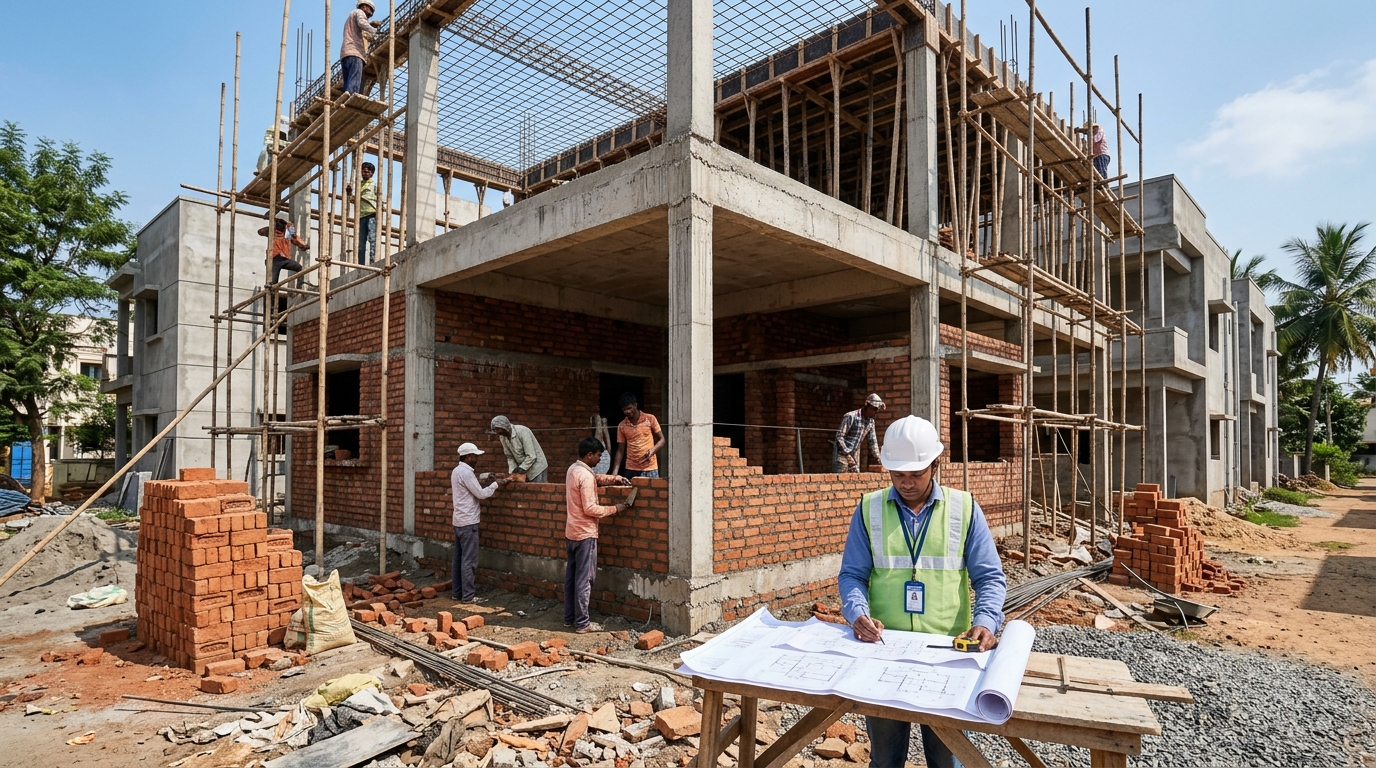
When embarking on house construction in India, selecting the correct grade and manufacturing type of cement directly governs your building's lifespan, resistance to moisture, crack susceptibility, and long-term durability. Based on industrial manufacturing processes and mineral admixtures, cement is fundamentally divided into two major classes: Ordinary Portland Cement (OPC) and Blended Cements (PPC & PSC).
1. Ordinary Portland Cement (OPC)
Ordinary Portland Cement is manufactured by grinding Portland clinker (derived by calcinating limestone and clay at 1450°C) with approximately 3% to 5% of gypsum to regulate setting time. Under the Bureau of Indian Standards (BIS), OPC is categorized into three standardized compressive grades:
- OPC 33 Grade (IS 269): Characterized by a 28-day characteristic compressive strength of 33 N/mm². Rarely used for modern load-bearing RCC work today; largely reserved for non-structural masonry and sub-base leveling.
- OPC 43 Grade (IS 8112): Develops 43 N/mm² compressive strength at 28 days. Widely specified for residential RCC framing (beams, columns, lintels) and precast concrete work.
- OPC 53 Grade (IS 12269): High early-strength cement attaining at least 53 N/mm² compressive strength. Ideal for multi-story framed buildings, rapid shuttering removal cycles, and heavy structural foundations.
Because OPC 53 hydrates very rapidly, it releases significant heat of hydration. If curing water is not applied diligently for at least 10–14 days, thermal micro-cracks will appear across large slabs and shear walls.
2. Blended Cements: PPC & PSC
Blended cements are produced by inter-grinding or thoroughly blending OPC clinker with pozzolanic materials or industrial by-products such as fly ash or granulated blast-furnace slag. The two predominant blended cements in India are:
A. Portland Pozzolana Cement (PPC — IS 1489)
PPC is manufactured by blending 15% to 35% of reactive siliceous fly ash (from thermal power stations) with clinker and gypsum. As cement hydrates, calcium hydroxide [Ca(OH)₂] is liberated; the pozzolanic fly ash reacts with this free lime to produce secondary Calcium Silicate Hydrate (C-S-H gel). This secondary gel densifies concrete pores, creating superior waterproofing and chemical resistance against sulphate attack and dampness.
B. Portland Slag Cement (PSC — IS 455)
PSC incorporates 25% to 70% granulated blast furnace slag from steel plants. PSC exhibits exceptional resistance to chloride and seawater corrosion, making it the premier choice in coastal belts and soil conditions with high salinity.
OPC vs Blended Cement (PPC): Side-by-Side Comparison
| Performance Criterion | Ordinary Portland Cement (OPC) | Portland Pozzolana Cement (PPC) |
|---|---|---|
| Early Strength (3–7 Days) | Very High & Fast | Moderate (catches up by 28–90 days) |
| Heat of Hydration | High (Prone to thermal cracking) | Low (Minimal crack risk) |
| Impermeability & Waterproofing | Moderate porosity | Exceptionally high (Dense C-S-H micro-structure) |
| Curing Requirement | Minimum 7–10 days | Continuous 14–21 days recommended |
| Ideal House Application | Columns, fast-track RCC, prestressed beams | Roof slabs, external plaster, brickwork, basement |
Which Cement Should You Use for Your House?
- For Foundation, Beams & Columns (Structural Frame): OPC 43 or OPC 53 provides fast strength gain, allowing timely deshutting of vertical formwork. PPC is also fully compliant and often preferred for durability.
- For Roof Slabs: PPC is generally recommended over OPC because its lower heat of hydration prevents plastic shrinkage cracks and makes the slab naturally watertight.
- For Brickwork & Internal/External Plaster: Always use PPC. It gives a smoother finish, superior workability, higher cohesiveness, and guards against efflorescence (shora/white salts).
Always inspect the manufacturing date printed on the cement bag. Cement loses approximately 10% strength per month of storage due to ambient moisture. Never use cement bags that are more than 90 days old without lab testing.